
AdaBoost
AdaBoost 是第一个被证明有效的 Boosting 算法。它通过"专注于难例"的方式,将多个弱分类器提升为强分类器。
1. 核心思想
Adaptive Boosting(AdaBoost) 的核心:让后续的学习器更关注被前面学习器分错的样本。
具体实现:
- 给每个样本分配权重(初始相等)
- 训练弱分类器
- 增加分错样本的权重,降低分对样本的权重
- 重复 2-3 步,最终加权组合所有弱分类器
2. 算法步骤
初始化:每个样本权重
对第
用加权样本训练弱分类器
计算加权错误率:
计算该分类器的权重(越准确权重越大):
更新样本权重:
归一化使权重之和为 1。
最终预测:
3. 代码实现
python
import numpy as np
import matplotlib.pyplot as plt
from sklearn.ensemble import AdaBoostClassifier
from sklearn.tree import DecisionTreeClassifier
from sklearn.datasets import make_classification
from sklearn.model_selection import train_test_split
from sklearn.metrics import accuracy_score

# 生成数据
X, y = make_classification(n_samples=500, n_features=10, random_state=42)
y = np.where(y == 0, -1, 1)  # 转为 -1/+1

X_train, X_test, y_train, y_test = train_test_split(X, y, test_size=0.2)

# AdaBoost(基学习器用深度为1的决策树,即"决策桩")
ada = AdaBoostClassifier(
    estimator=DecisionTreeClassifier(max_depth=1),  # 弱分类器
    n_estimators=100,    # 弱分类器数量
    learning_rate=1.0,   # 学习率
    algorithm='SAMME',   # 多分类算法
    random_state=42
)
ada.fit(X_train, y_train)
y_pred = ada.predict(X_test)
print(f"AdaBoost 准确率: {accuracy_score(y_test, y_pred):.4f}")

# 查看随着迭代次数增加,准确率的变化
staged_scores = [accuracy_score(y_test, y_pred_s)
                 for y_pred_s in ada.staged_predict(X_test)]

plt.figure(figsize=(10, 5))
plt.plot(range(1, len(staged_scores)+1), staged_scores, 'b-', linewidth=2)
plt.xlabel('弱分类器数量')
plt.ylabel('测试准确率')
plt.title('AdaBoost:随迭代次数增加的性能')
plt.grid(alpha=0.3)
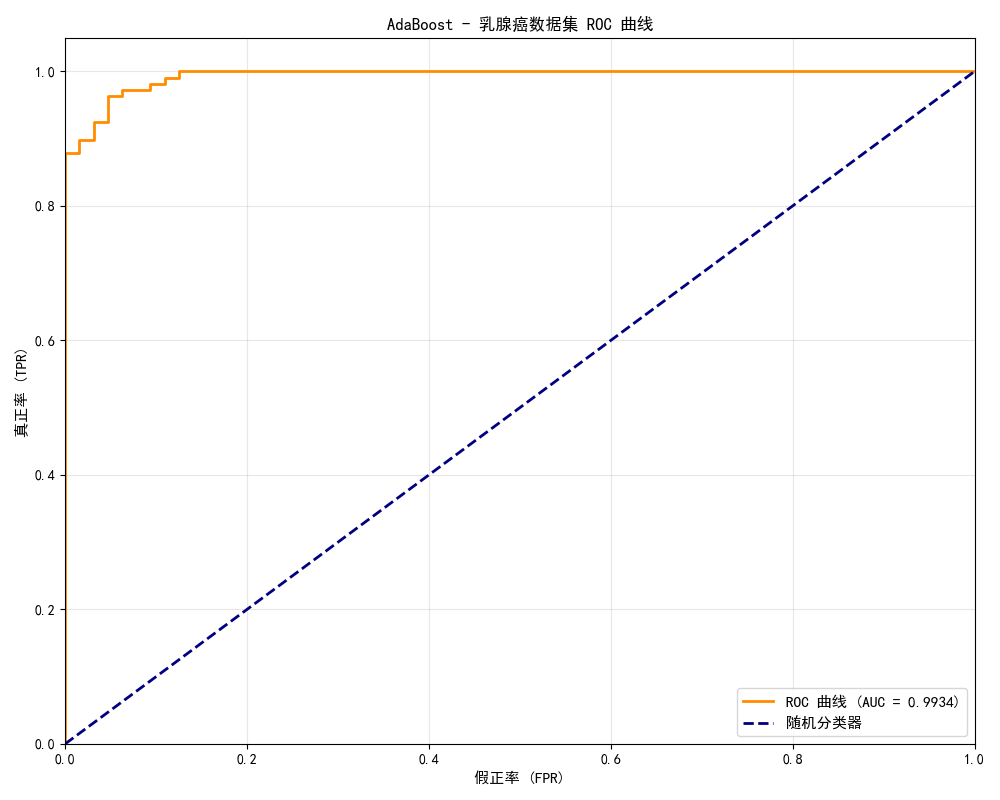
plt.show()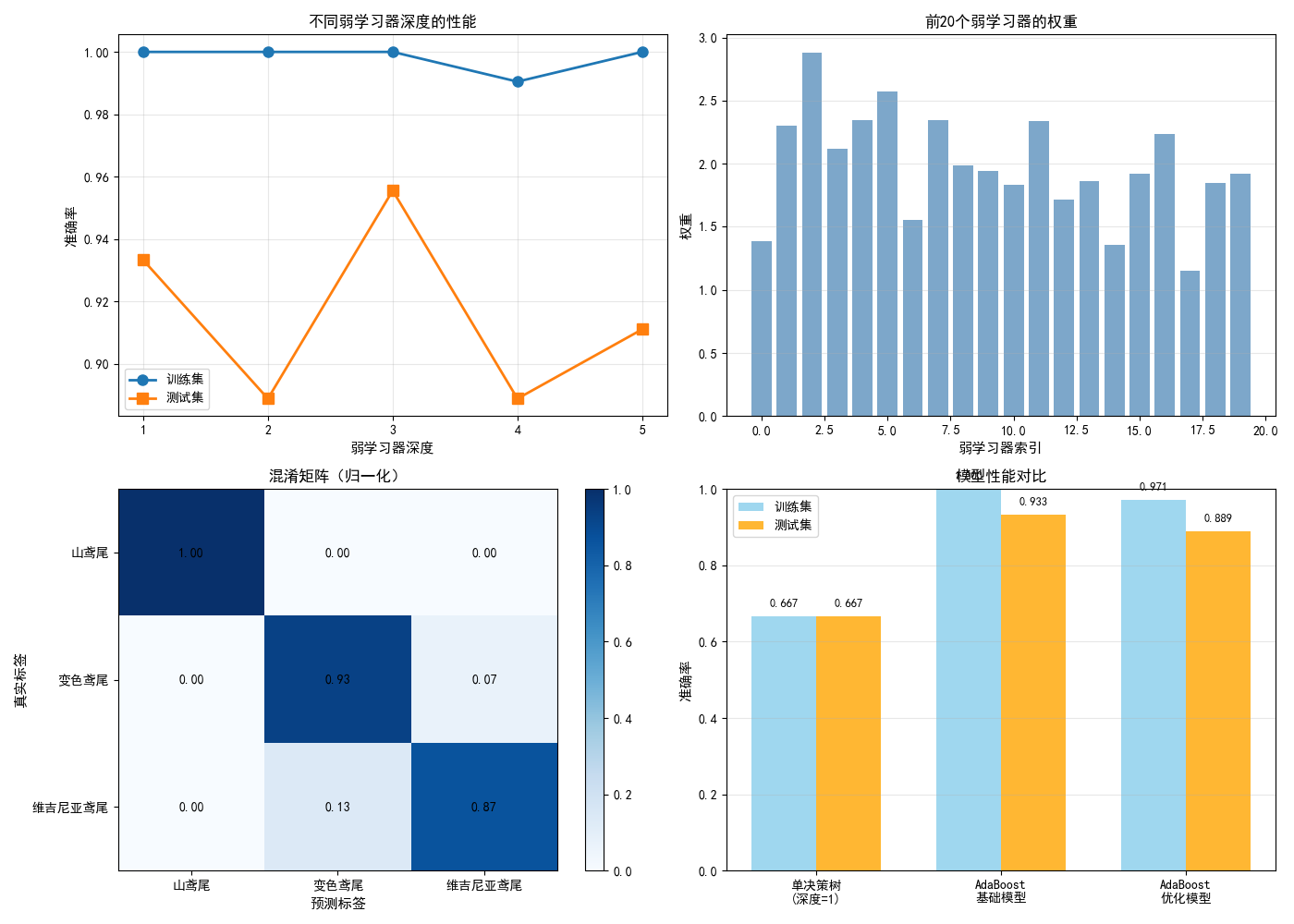
4. 从零实现
python
import numpy as np

class AdaBoost:
    def __init__(self, n_estimators=50):
        self.n_estimators = n_estimators
        self.estimators = []
        self.alphas = []

    def fit(self, X, y):
        n = len(y)
        weights = np.ones(n) / n  # 初始等权重

        for m in range(self.n_estimators):
            # 训练弱分类器(决策树桩)
            from sklearn.tree import DecisionTreeClassifier
            clf = DecisionTreeClassifier(max_depth=1)
            clf.fit(X, y, sample_weight=weights)
            y_pred = clf.predict(X)

            # 计算加权错误率
            incorrect = (y_pred != y)
            epsilon = np.sum(weights[incorrect])

            if epsilon >= 0.5:  # 弱分类器比随机猜测还差,停止
                break

            # 计算分类器权重
            alpha = 0.5 * np.log((1 - epsilon) / (epsilon + 1e-10))

            # 更新样本权重
            weights *= np.exp(-alpha * y * y_pred)
            weights /= weights.sum()  # 归一化

            self.estimators.append(clf)
            self.alphas.append(alpha)

        return self

    def predict(self, X):
        # 加权投票
        H = np.zeros(len(X))
        for clf, alpha in zip(self.estimators, self.alphas):
            H += alpha * clf.predict(X)
        return np.sign(H)
5. 优缺点
优点
- ✅ 简单且有效:实现简单,理论保证
- ✅ 不容易过拟合:特别是在弱分类器的情况下
- ✅ 可以用于多分类(SAMME 变体)
缺点
- ❌ 对噪声和异常值敏感:被多次增加权重,影响大
- ❌ 串行训练,速度慢
- ❌ 在现代应用中,XGBoost/LightGBM 通常更好
总结
| 特性 | AdaBoost |
|---|---|
| 提出时间 | 1995(Freund & Schapire) |
| 核心机制 | 自适应样本权重 |
| 弱分类器 | 通常用决策树桩(深度=1) |
| 集成方式 | 加权投票 |
| 历史意义 | 第一个实用的 Boosting 算法,影响深远 |